The City of Nawabs
Lucknow was the cultural capital of the Nawabs of Awadh, a dynasty that ruled this region of northern India in the eighteenth and early nineteenth centuries. Under their patronage, the arts flourished — music, poetry, dance, cuisine, and above all, the textile crafts that would define the city's identity for centuries to come. The nawabs were connoisseurs of refinement. They surrounded themselves with beauty and demanded excellence from the artisans who served their courts.
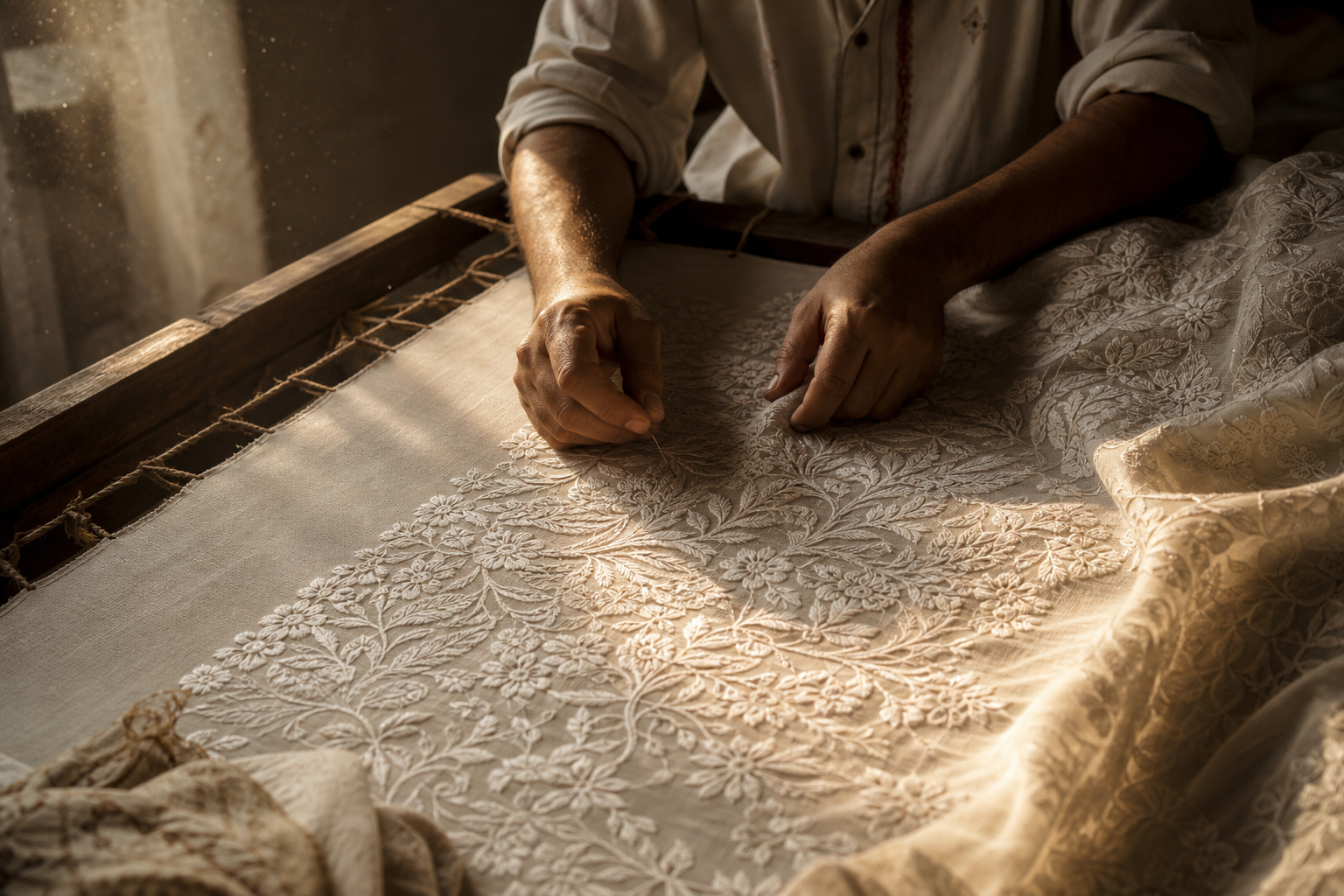
It was in these courts that Chikankari reached its zenith. The nawabs wore fine muslin embroidered so delicately that it was described as woven air — baft hawa. Artisans competed to produce the finest work. Techniques were refined to a degree of subtlety that still astonishes those who study them today.
Persian Threads
The word chikankari is believed to derive from the Persian word chikan, meaning fine embroidery. The Persian influence on Lucknow's aesthetics was profound — carried through the Mughal court and deepened by the Awadhi nawabs, who maintained strong cultural ties to Persia. The sinuous floral motifs, the vine patterns, the emphasis on restraint over excess — all of these bear the mark of Persian aesthetic values filtered through an Indian sensibility.
Over time, the craft adapted. Local motifs — the mango (keri), the lotus, the jasmine — joined the Persian vocabulary. Indian stitching techniques merged with imported patterns. What emerged was something entirely new and entirely its own: neither Persian nor purely Indian, but Lucknawi.
“Lucknow did not just preserve Chikankari. It gave it a soul — a sense of refinement that belongs entirely to this city.”
The Living Tradition
Today, Chikankari is Lucknow's most significant craft industry. Tens of thousands of artisans — the majority of them women — work in the city's homes and workshops, producing embroidered garments and textiles that are sold across India and internationally. The old mohallas of the city, particularly around Chowk and the areas surrounding the Imambara, remain the heart of this tradition.
To walk through these streets is to understand what it means for a craft to be truly alive. The sound of needles on fabric drifts from open windows. Children learn by watching. Fabric rolls are carried on bicycles. Finished pieces hang to dry in courtyards. This is not a museum. It is a living, working, evolving culture.
Naqsh is rooted in Lucknow — not just as a source of product, but as a community, a history and a responsibility. Every piece we curate is made here, by artisans we know by name, in a tradition we are committed to preserving. The city's story is woven into every thread.